


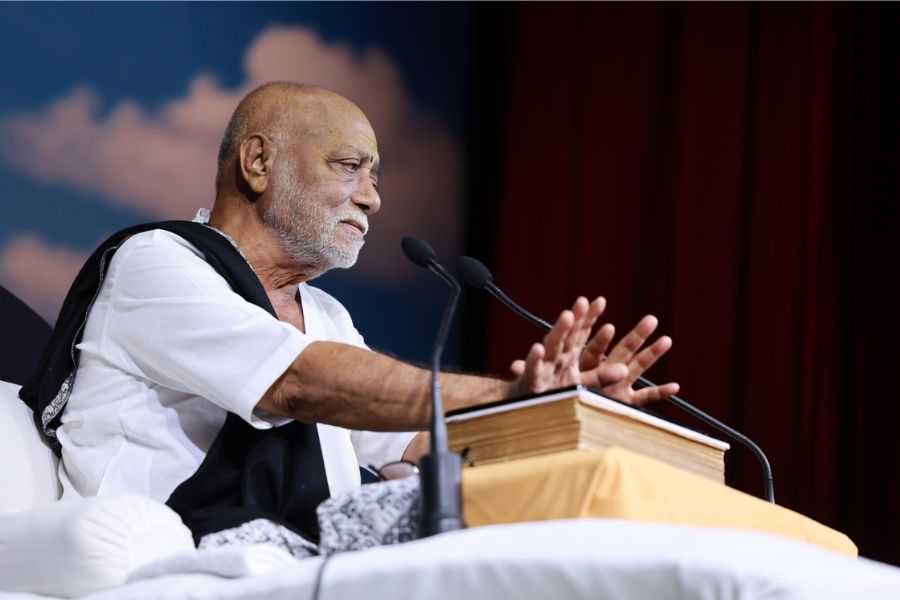
Morari Bapu explains the 9 qualities of Garuda, the importance of chanting the holy name in Langkawi Ram Katha
Ahmedabad (Gujarat) [India], April 10: Langkawi, an island in Malaysia, literally means a reddish-brown eagle (or a Brahminy kite). The word Langkawi itself is a conjunction of two Malay words for eagle, ‘Helang’ (colloquially shortened to lang), and ‘Kawi’ is a red stone. The bird thus closely resembles the holy bird Garuda in Hindu philosophy.
It is precisely for this reason that Morari Bapu has chosen the topic of ‘Manas Garuda’ for the Langkawi Katha.
He has picked two lines from the Uttar Kand as the central theme for the Katha:
Garuda Mahagyani Guna Raasi, Hari Sevak AtiNikatNivasi (55.3)
Gayayu Garuda JahaBasaiBhusunda, Mati Akuntha Hari Bhagat Akhnada (63.1)
(Garuda is highly enlightened and an embodiment of virtues. Moreover, he is the server of Shri Hari (the vehicle of Vishnu) and lives very close to him. Garuda went to the abode of Bhusundi with unhampered intellect and possessing of irrevocable devotion towards Shri Hari.)
He then went on to explain how the lines contain within them the mention of the superior qualities of the holy bird Garuda. There are six in these two lines, and three primary more mentioned in another context in the Ramayana, making them a total of 9 qualities. Here, Garuda is firstly mentioned as ‘Mahagyani’, i.ehighly enlightened and secondly called ‘Guna Raasi’, which means an embodiment of virtues. He has the supreme quality of being employed in the service of Sri Hari or Vishnu as his vehicle. Fourthly, he has then the fortune of dwelling close to his Master by virtue of being his vehicle. His intellect is refined and devotion unwavering.
Morari Baputhen urged listeners to visualize a picture of Garuda. It can be seen that when Garuda flies, it has a snake in its claws. A snake in Hindu thought represents ‘Kaal’, which means death. It also thus denotes time. Bapu explained that the “timing” of every event in your life is extremely important, and we can hasten or delay things as everything has a perfect time of occurrence.
He then said that a Garuda’s wings represent both ‘Vaig’, which means speed and ‘Vedas’ – the sacred texts. And Garuda has extremely sharp eyesight, which symbolizes farsightedness.
Bapu elaborated on the point of farsightedness and explained that when in life we sometimes get ruffled, it is because we have a very narrow vision, but when we take our matters to our Guru, his decision is based on a long-term view because he is in possession of farsightedness.
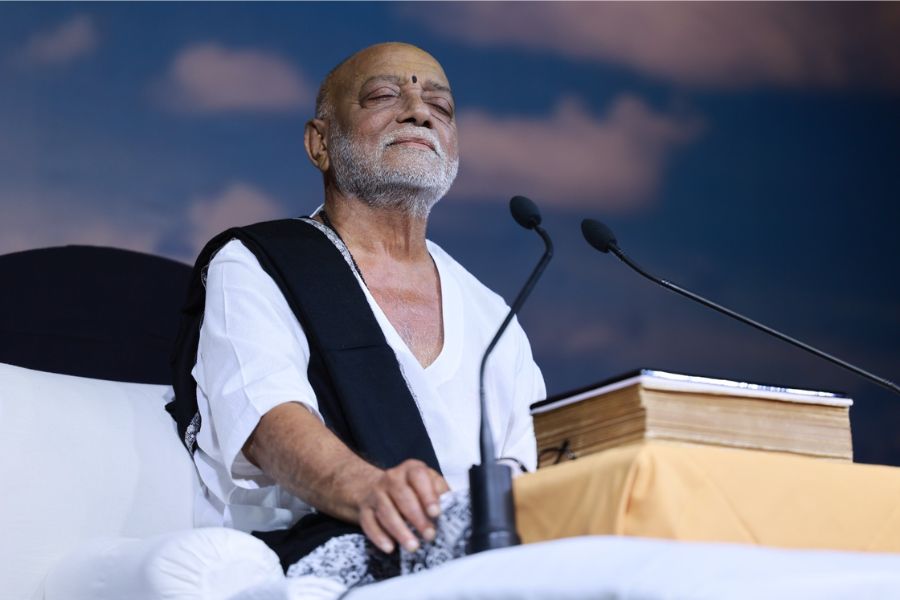
Bapu also spoke elaborately on the significance of ‘Ram Naam’, i.e. chanting of the holy name. He revealed that his grandfather and SadaguruTribhuvana Das had told him that though there would be several expert commentators of Ramayana in the world, Bapu should not fall into comparisons and rather stick with the main goal of getting people to chant the holy name. He also lauded that people of North Indian states like Haryana and Punjab often ask only for one spiritual donation, and that is ‘Naam Daan’ – the ability to chant the holy name ceaselessly.
Bapu also felt that there were three ways of becoming ‘Vigalita’ in devotion – that is, fully immersed in God. First if by chanting the holy name, second in by entering the periphery or area where spiritual congregations are taking place and third, by dancing in ecstasy to the holy name and devotional songs.
He explained the nuanced difference between ‘Visarjit’, which means to scatter, compared to ‘Vigalit’, which means to immerse completely. For example, ashes, when put in a river, become scattered in it, meaning ‘Visarjit’; but when we add salt in the sea, it melts into the waves and becomes one with the sea. That phenomenon is called ‘Vigalit.’
Langkawi is an archipelago made up of 99 islands on the west coast of Malaysia. Surrounded by the Andaman Sea, the main island offers a mixture of swaying paddy fields, jungle-clad hills that are peppered with voluminous waterfalls and a sprawling shoreline that is fringed by powder-fine sand and looming coconut trees.
It is amid such pleasing surroundings that the famous spiritual luminary from India, Morari Bapu, is holding his 9-day discourse in Langkawi till April 16. The Katha is being held at Pelangi Beach Resort and commences daily around 10 am. The discourse lasts for about 3.5 hours and is followed by a vegetarian meal for all attendees. The organisers, Mitul Jobanputra and Kishor Jobanputrafrom from Uganda, have arranged all three meals for those attending the Katha at the hotel itself. The Jobanputra family have been devotees of the Ramayana exponent Morari Bapu since 1976 and have helped organized other Kathas in the past in places like Jinja, Dubai and Goa.
Morari Bapu has been giving expositions on the Ram Charita Manas written by Goswami Tulsidas since the supple age of 14; Langkawi Katha is his 915th in the series. Normally, Bapu picks two lines from the epic and explains them in detail over 9 days, adding context from the various sacred scriptures, anecdotes, folklore and more. The idea is to plant the root meaning of these lines and to understand their antecedent and relevance in the larger concept of the text as well as life.
Morari Bapu, who is attributed with taking the Ramayana to the homes and hearts of the people all over India and the world, connects all teachings with morals and ideals that need to be incorporated into daily living to bring more joy and peace in people’s lives. According to him, Dharma, or the moral code, comprises three main universal values of ‘Truth, Love and Compassion.
If you have any objection to this press release content, kindly contact pr.error.rectification[at]gmail.com to notify us. We will respond and rectify the situation in the next 24 hours.
