

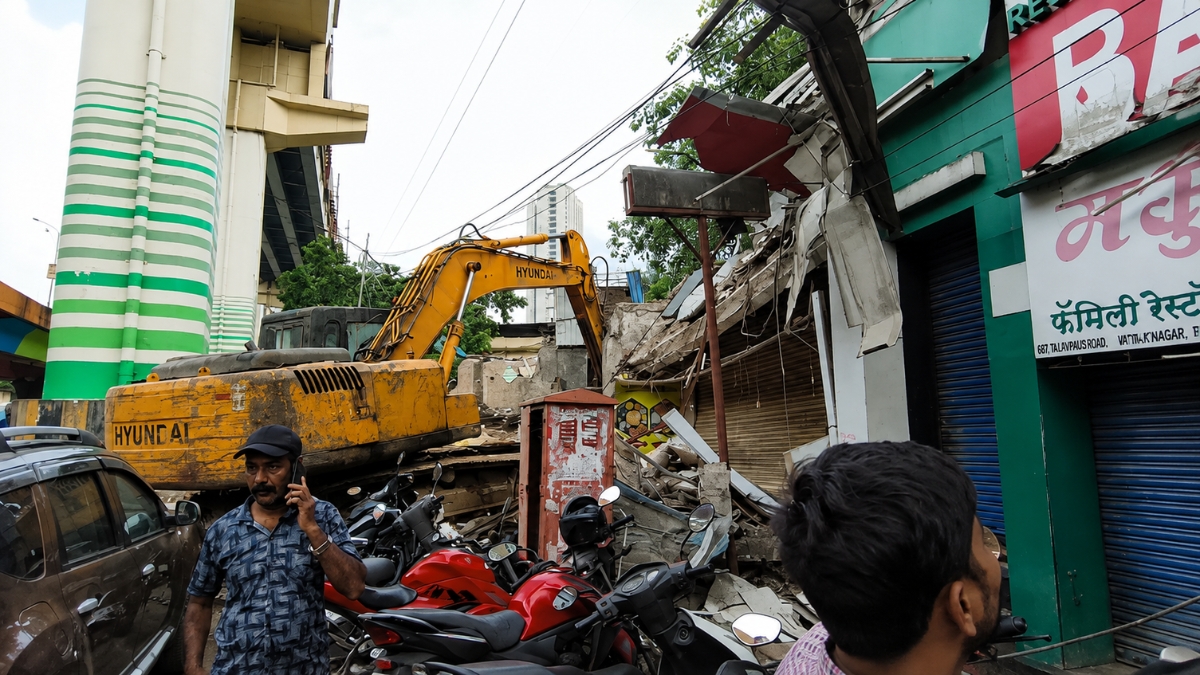
Thane (Maharashtra) [India], August 8: In a matter where the complete truth is still buried beneath competing claims, legal proceedings and administrative records, one thing is increasingly difficult to ignore: ordinary people appear to be facing the consequences of a dispute they did not create.
The controversy surrounding Survey No. 349/3 at Mouje Majiwada, Taluka and District Thane, has taken a deeply unsettling turn following an order by the Tehsildar and Agricultural Lands Tribunal directing the removal of houses, shops and other structures standing on the disputed land.
Whether every claim made by either side is ultimately found to be correct is a matter for the competent authorities and courts to determine. But the circumstances surrounding the proposed demolition have already triggered serious questions about fairness, transparency and the manner in which such an action can affect the lives of people who have built homes, businesses and livelihoods around the property.
At its heart, this is no longer merely a question of land records.
It is a question of what happens to people when an old and contested property dispute suddenly produces an order with potentially irreversible consequences.
The records indicate that the matter involves competing claims relating to ownership and possession, long-standing structures, registered transactions, revenue proceedings and previous litigation. The applicants have also raised claims concerning land belonging to a Scheduled Tribe and protections under Sections 36 and 36A of the Maharashtra Land Revenue Code.
With so many layers surrounding the property, the obvious public concern is whether every relevant issue has been examined with the degree of caution expected before structures inhabited or used by people are ordered to be removed.
When an Order Can Change Lives Overnight
For the residents and businesses affected by the proposed action, the matter cannot be viewed merely through the language of survey numbers, revenue records and administrative proceedings.
Behind every structure stands a human story.
There may be families who have spent years living there, businesses that depend upon those premises, employees whose incomes are linked to those establishments and individuals who may have nowhere else to turn if demolition takes place.
That is why the urgency surrounding the proposed action has become a matter of public concern.
The question is not whether laws should be enforced. The question is whether enforcement can be carried out without first ensuring that every affected person has a meaningful opportunity to understand, challenge and respond to the decision.
Where Is the Clear Route to Appeal?
One of the most striking concerns surrounding the order is the apparent absence of a clear indication of the appellate or revisional remedy available to affected persons.
The order directs the respondents to remove the structures standing on the disputed property. Yet affected citizens have a legitimate need to know where they can challenge such a decision, which authority has jurisdiction to hear their grievance and what statutory time limit applies.
This becomes particularly important when the consequence of administrative action could be irreversible.
A citizen facing demolition should not have to discover the route to legal protection after the demolition process has already begun.
The absence of clear information regarding available remedies does not, by itself, establish that the order is legally invalid. However, where homes and livelihoods are potentially at stake, the issue warrants careful examination from the standpoint of procedural fairness and access to justice.
A Court Direction Does Not End Every Question
Available records indicate that the Bombay High Court directed the concerned Tehsildar to consider the applicants’ representation and take a decision within a stipulated period.
The distinction between being directed to decide a representation and being directed to demolish structures is therefore important.
An administrative authority deciding a matter following a court direction must still act within the scope of its statutory powers and consider the competing claims placed before it.
That makes the reasoning behind the final order particularly significant.
What material was examined before the decision was reached? What competing claims were considered? Were all affected parties given an effective opportunity to present their case?
These are questions that deserve answers rather than assumptions.
The Question Nobody Can Afford to Ignore: What Happens Next?
The proposed demolition has also generated a larger question that goes beyond the immediate dispute.
If the structures are removed, what happens to the land thereafter?
Who ultimately takes possession?
Is any development proposed on the property?
Are there any Development Agreements, Memoranda of Understanding, Powers of Attorney, layout plans, building proposals, consent terms or other arrangements involving private entities?
At present, these questions should be treated as questions requiring verification—not as proof of any wrongdoing.
If no private developer or commercial interest is connected with the property, the matter should be clarified publicly. If such an interest exists, transparency becomes even more important.
The public deserves to understand what lies beyond the immediate question of demolition.
Allegations of Private Interests Require an Independent Answer
Some affected residents have alleged that the proposed action could ultimately facilitate private development interests and have questioned the role of certain officials.
Those allegations remain allegations and should not be treated as established facts without evidence.
At the same time, dismissing them without examination would also leave an unnecessary cloud over the entire process.
That is precisely why an independent inquiry has been demanded.
An impartial examination of the records, correspondence, official file notings, permissions and decisions would help establish whether the process was entirely administrative and lawful, or whether any outside influence played a role.
If there is nothing improper, an independent inquiry can establish that. If irregularities are discovered, the same process can identify where accountability lies.
Either way, transparency benefits everyone.
The Human Cost Cannot Become an Administrative Footnote
Land disputes can continue for years. Documents can be contested, ownership can be litigated and claims can change hands.
But people cannot put their lives on hold indefinitely.
For a family, a house is not merely a structure on a survey map. For a shopkeeper, a commercial premises is not simply an entry in a revenue record. It may represent decades of investment, employment and financial security.
That is why any action involving demolition must be approached with extraordinary care.
The law may ultimately determine who has the stronger claim to the land. But until that process is meaningfully exhausted, the human consequences of irreversible action deserve equal attention.
The Questions That Remain
Several questions therefore continue to demand clear answers:
- Who will ultimately take possession of the property if the structures are demolished?
- What is proposed for the land after demolition?
- Is any builder, developer or private entity connected with the property?
- Are any development proposals or related documents pending before Government authorities?
- What do the official files and correspondence reveal about the decision-making process?
- Why does the order not clearly identify the appellate or revisional remedy available to affected citizens?
- Were all affected residents given a meaningful opportunity to challenge the proposed action?
- What explains the urgency surrounding demolition when the property is subject to competing claims and a long history of proceedings?
These questions do not prejudge the final legal outcome.
They simply reflect the concerns of people who may bear the consequences of a decision that cannot easily be reversed.
A Call for Transparency Before Irreversible Action
The demand being raised is therefore straightforward: make the complete record available, allow independent scrutiny and ensure that affected citizens have meaningful access to every legal remedy available to them before any irreversible action is taken.
An independent inquiry headed by a retired High Court Judge or an equivalent senior authority could examine the legality, jurisdiction, reasoning and administrative process behind the decision.
The relevant development documents, Government file notings, permissions, proposals and correspondence concerning the property should also be placed under appropriate scrutiny.
Until these questions are adequately addressed, maintaining the status quo would provide an opportunity for all sides to pursue their remedies without creating consequences that cannot be undone.
This is not a demand to declare one party right and another wrong.
It is not a demand to shield anyone from lawful action.
It is a demand for fairness before finality.
Because when an administrative decision can potentially take away a home, disrupt a livelihood or dismantle a business, the process leading to that decision matters as much as the decision itself.
Nobody should have to discover the value of due process only after their home has been demolished.
The truth may eventually emerge through the courts, official records or an independent inquiry.
Until then, the most responsible course is not to rush toward irreversible action, but to answer the questions that have unsettled the people of Majiwada.
Make the file transparent. Make the process accountable. Give every affected citizen a meaningful opportunity to be heard. And until those safeguards are exhausted, let no home be reduced to rubble.
