

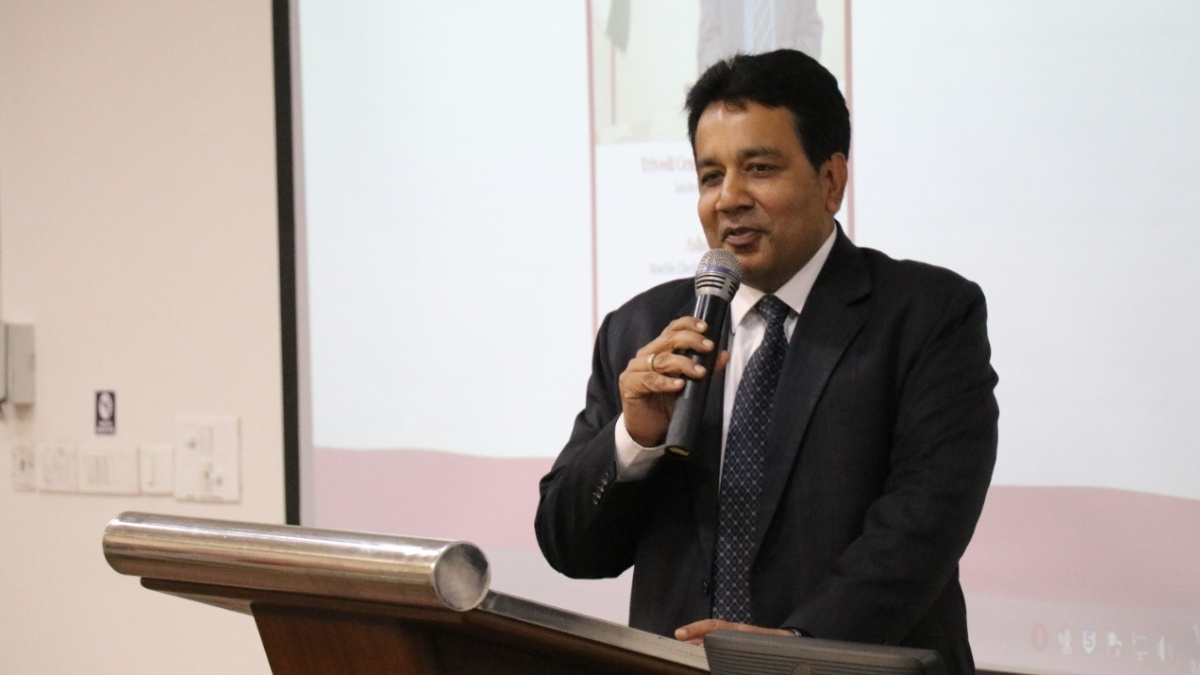
Pranav Gupta examines how rising costs, changing visa rules and new global education options are making Indian families more selective about the real ROI of studying abroad.
New Delhi [India], October 23: For decades, studying abroad was sold to Indian families as a near-automatic investment in upward mobility: secure admission in the US, Canada, the UK or Australia, arrange the loan, and trust that an international degree would justify the cost. That assumption is becoming harder to make.
For Pranav Gupta, co-founder of Ashoka University, Plaksha University and Jamboree Education, the shift is increasingly about judging the educational experience rather than the country attached to it. “Students should look beyond the location or the foreign name attached to an institution,” he said recently while discussing international higher education.
Government numbers point to a clear moderation in outbound movement. Bureau of Immigration data presented by the Ministry of Education show that Indians declaring study or education as their purpose for overseas travel fell from 894,758 in 2023 to 760,060 in 2024 and 619,264 in 2025 – a decline of about 31% in two years. These are travel-purpose figures, not a census of all Indians enrolled overseas, but they capture a meaningful change in momentum.
The United States illustrates the complexity. The Open Doors 2025 report counted 363,019 Indian students in the US in 2024-25, up 9.5% year-on-year and the highest of any country of origin. Yet Indian graduate enrolment fell 9.5%, while the number of Indians on Optional Practical Training jumped 47.3% to 143,740. The existing Indian student population therefore remains enormous even as newer demand shows signs of becoming more selective.
The policy environment is also becoming harder to ignore.
Britain’s Graduate visa will fall from two years to 18 months for most bachelor’s and master’s graduates applying from January 1, 2027. Canada, meanwhile, expects to issue up to 408,000 study permits in 2026, 7% below its 2025 target and 16% below its 2024 target.
And the uncertainty has intensified in the US. In October, the Department of Homeland Security proposed an initial $70,000 fee for each F-1 student OPT recommendation made by a participating institution. The proposal has not yet become final policy, but it demonstrates how dramatically the economics surrounding post-study work can change after a student has already made a substantial educational investment.
This is helping create a more destination-specific approach.
Germany had 59,419 Indian students in the 2024-25 winter semester, making India its largest international source country and representing roughly 20% annual growth, according to DAAD. Reuters has also documented increased Indian interest in Germany, France, the Netherlands and Portugal as families compare tuition costs, employment pathways and visa conditions more carefully.
Pranav Gupta had anticipated this diversification several years ago, observing that “more nations in Europe and the Middle East have come up to draw students to their shores.” What looked like an emerging alternative then is becoming a much more consequential part of the decision today.
The biggest change, however, may be in how families calculate value.
Tuition is only the starting point. Housing, currency risk, education-loan interest, university quality, employability in the chosen field, post-study work rights and the probability of securing a relevant job all need to enter the calculation. A cheaper degree with weak employment prospects can ultimately produce a poorer return than a more expensive programme with substantially stronger outcomes.
There is also a new competitor to the traditional study-abroad model: global education without migration.
The UGC has issued 16 Letters of Intent to foreign higher education institutions, while the University of Southampton has established its Gurugram campus and UNSW has established one in Bengaluru. Programmes proposed by foreign institutions span business, finance, AI, cybersecurity, data science and other emerging fields.
Gupta believes such developments can “expand the choices available to Indian students.” The implication is significant: families may increasingly compare an overseas degree not only with Indian universities, but also with the Indian campus of an international institution.
None of this suggests that Indian students are losing their global ambitions. The US remains a major destination, Germany is gaining strongly, and new markets continue to emerge.
What is fading is the idea that a foreign degree is automatically worth any price.
For families in 2026, the more useful question is no longer simply, “Which country should my child study in?”
It is: What will this degree cost in total, what opportunities will it realistically create, and is there a better route to the same outcome?
That is not the end of the Indian study-abroad dream. It is the beginning of a much more calculated one.
