

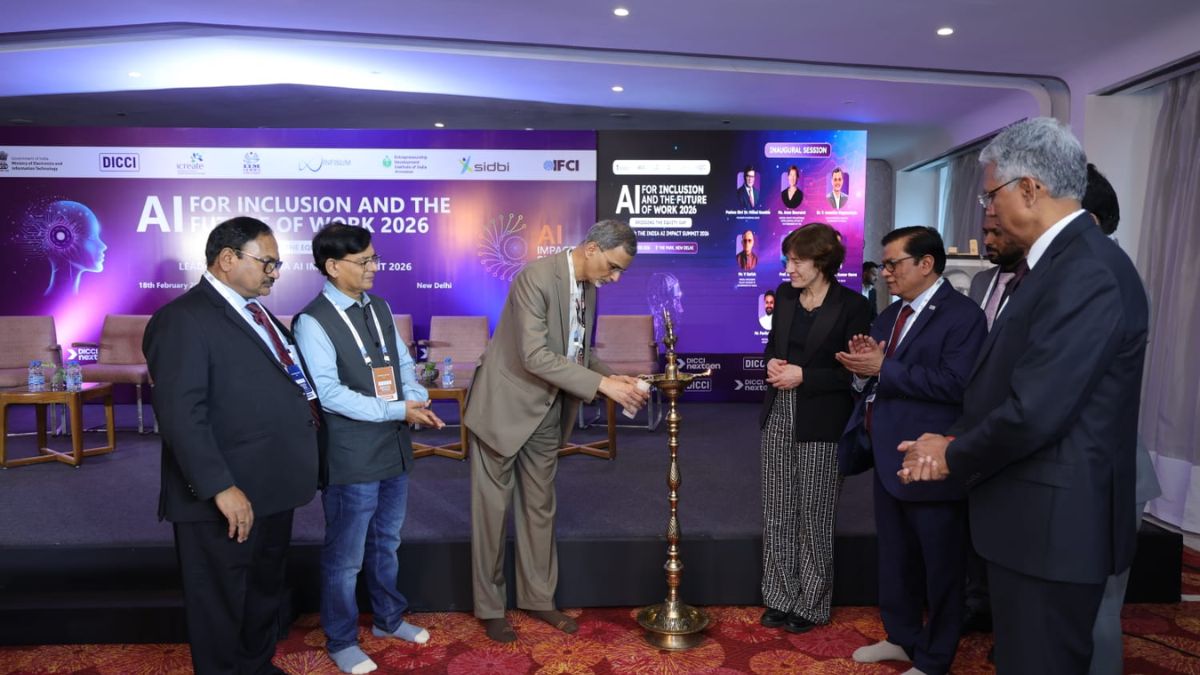
New Delhi [India], February 18: The Dalit Indian Chamber of Commerce and Industry, (DICCI), hosted the International Conclave titled AI for Inclusion & the Future of Work 2026: Bridging Divides, Building Futures at The Park Hotel, New Delhi. The conclave brought together senior policymakers, global representatives, industry leaders and academic institutions to deliberate on how artificial intelligence can be shaped as a force for equitable growth and livelihood security. The event served as a strategic lead-in to the India AI Impact Summit 2026.
Chief Guest Dr. V. Anantha Nageswaran, Chief Economic Advisor to the Government of India inaugurated the DICCI’ International Conclave on AI for Inclusion and the Future of Work, and emphasized that productivity gains from AI must be complemented by investments in skilling, institutional preparedness and equitable access to digital infrastructure to ensure sustained and broad-based growth.
From a global governance perspective, Ms. Anne Bouverot, Special Envoy for Artificial Intelligence to the President of France stressed that trust, transparency and human-centric design are essential to building AI systems that serve society at scale. She noted the importance of international cooperation in ensuring that AI standards reflect democratic values and inclusive development priorities.
Addressing the conclave, Dr. Milind Kamble, Founder Chairman, DICCI, said, “Our focus must be clear i.e., education that delivers excellence, entrepreneurship that creates empowerment, and technology that drives transformation. A child in a tribal village or remote hill area must have access to the same quality of education taught at Harvard or Oxford. We must shift the narrative from victimhood to leadership, so that communities once excluded become architects of India’s growth. With 73 percent of our economy in the informal sector, AI must accelerate formalisation and expand opportunity. By 2047, development must be measured not only by GDP, but by dignity, participation and shared prosperity.”
Mr. Avinash Punekar, CEO, iCreate said “AI carries both immense promise and serious risk. Women remain underrepresented in AI leadership, and if its trajectory is left concentrated in a few hands, the socio-economic consequences can be significant. Just as financial systems required regulation after the 2008 crisis, AI now requires formalisation, accountability and clear governance to ensure its benefits are inclusive and its risks are contained.”
Prof. B. S. Sahay, Founder Director, IIM Jammu, emphasised that inclusion becomes meaningful only when it leads to measurable enterprise creation and income stability. Drawing from DICCI’s experience in economic empowerment initiatives, he noted that structured policy intervention, when aligned with institutional support, can transform vulnerable communities into organised entrepreneurs.
The conclave was structured around four institutional pillars: Global, Thinktank & Policy Advisory, Industry and Academia ensuring balanced representation across decision-making ecosystems. The Global pillar featured, and Ms. Maya Sherman, Innovation Attaché, Embassy of Israel in India. The Thinktank and Policy pillar included Dr. V. Anantha Nageswaran, Chief Economic Advisor to the Government of India, and Mr. V. Satish, Social Inclusion Policy Advisor to the Government of India. Industry leaders included Mr. Avinash Punekar, CEO, ICreate; Mr. Ashish Chauhan, MD and CEO, National Stock Exchange of India; Ms Mercy Epao, Joint Secretary, Ministry of MSME, Government of India, Dr. Chris Merz, Mastercard; Mr. Angshuman Bhattacharya, Adani AI Labs; Mr. Hitesh Sachdeva, ICICI Bank; Mr. Nipun Mehrotra, The Agri Collaboratory; Mr. Rishi Bal, BharatGen; and Mr. Anjul Katare, Central Business Solutions. The Academia pillar was represented by Prof. B. S. Sahay, Founder Director, IIM Jammu; Dr. Vinita Sahay, Director, IIM Bodh Gaya; Dr. Sunil Shukla, Director General, EDII; Prof. Binod Kumar Kanaujia, Director, NIT Srinagar; and Dr. Nitin Upadhyay, Dean, IIM Jammu.
Across four thematic pillars, discussions moved from principle to implementation.
The first session examined AI inequality and global development. Participants highlighted the concentration of compute capacity and capital, and stressed the need for expanded access to infrastructure, inclusive datasets and targeted skills development to prevent the emergence of a widening AI divide.
The second session focused on governing AI for livelihoods and small businesses. Deliberations centered on enabling formalisation for MSMEs, enhancing access to credit and markets, and deploying AI tools in agriculture and local enterprise ecosystems. The discussion reinforced that informal workers and first-generation entrepreneurs must be equipped to transition into higher productivity roles.
The third session addressed governance and oversight. Speakers examined standards for transparency, auditability and accountability in AI systems, with particular attention to bias mitigation and representational diversity in data. The importance of public disclosure norms in government-deployed AI systems was highlighted as critical to sustaining public trust.
The fourth session explored infrastructure, data and digital public goods. Industry and institutional leaders emphasized the expansion of compute infrastructure, multilingual AI systems and interoperable digital platforms to ensure equitable deployment across rural and urban geographies.
The conclave’s deliberations were anchored around seven development priorities i.e., Education, Healthcare, Agriculture, Speedy Justice, Financial Literacy, Unorganised Workers and Entrepreneurship. Participants outlined how AI-driven solutions can improve learning outcomes, expand preventive healthcare access, enhance agricultural productivity, enable faster dispute resolution, strengthen financial inclusion and support the formalisation of unorganised workers.
A key outcome of the conclave was the unveiling of the Delhi Declaration on AI for Inclusion and the Future of Work. The one-page document outlines shared principles on equity by design, worker transition pathways, inclusive digital infrastructure and responsible governance standards. The Declaration will be presented at the India AI Impact Summit 2026.
The conclave concluded with a synthesis session consolidating insights and policy recommendations aimed at building future-ready, inclusive work ecosystems. Through this initiative, DICCI built upon its emphasis to ensure that India’s AI trajectory remains anchored in constitutional values of equity, economic justice and inclusive development.
If you object to the content of this press release, please notify us at pr.error.rectification@gmail.com. We will respond and rectify the situation within 24 hours.
