

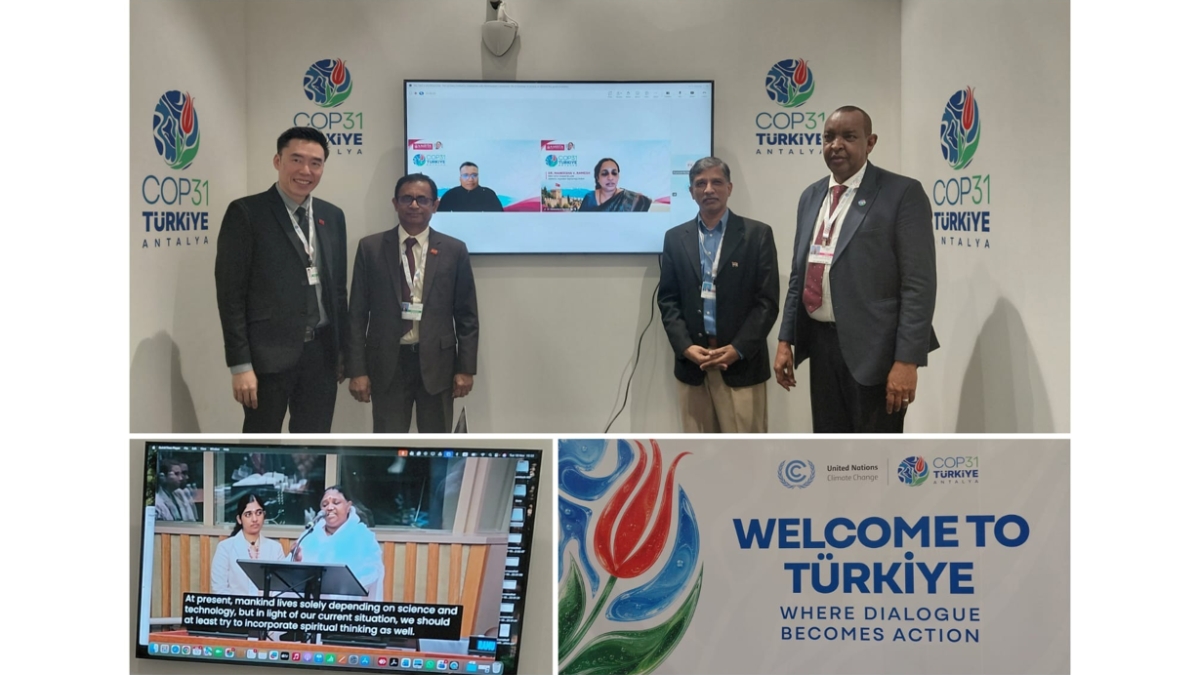
At the YÖK Pavilion in Antalya, Amrita Vishwa Vidyapeetham and partners from Nepal and Thailand called for university science to move faster from the laboratory to the last village, and to the last person.
Antalya [Türkiye], November 14: When the 31st United Nations Climate Change Conference, COP31, opened at the Antalya Expo Center on 9 November, its host had a clear message for the world. COP31 President-Designate Murat Kurum urged countries to make this an “Implementation COP”, one that turns climate pledges into results people can see. He invoked the Turkish idea of imece, a community coming together to finish a shared task.
That call matters most where climate change is already a daily reality. Floods, landslides, cyclones, glacial lake outbursts and extreme heat are hitting communities across South Asia, Southeast Asia and the wider Global South harder and more often, and adaptation is high on the COP31 agenda. This concern was echoed in a message from Amrita’s Chancellor, Mata Amritanandamayi Devi, popularly known as Amma where she called for harmonious coexistence between humans and nature and stressed the need to revive traditional values of compassion, sharing and respect for all living beings. She cautioned that environmental degradation and the exploitation of natural resources could have serious consequences for humanity.
That question was at the heart of a roundtable held on 10 November at the YÖK Pavilion in the COP31 Blue Zone, hosted by the Council of Higher Education of Türkiye (YÖK). Titled From Sensor to Settlement: Operationalising University-Led Disaster Risk Reduction and Locally Led Climate Resilience, the session was convened by Amrita Vishwa Vidyapeetham, India. It brought together university and regional experts, with participants joining both in person in Antalya and online.
Opening the session, Dr. Raghu Raman, Dean of the Amrita School of Business and UNESCO Chairholder, thanked YÖK for giving universities a place in the Blue Zone. The session was attended by Dr. Peeranan Towashiraporn, Director at the Asian Disaster Preparedness Center (ADPC), and Ibrahim Rashid Ahmed, Senior Presidential Advisor of the Republic of Kenya, among others.
The session was chaired by Dr. Maneesha Vinodini Ramesh, Pro Vice Chancellor of Amrita Vishwa Vidyapeetham and UNESCO Chairholder. Her team built one of the world’s first wireless sensor networks for landslide detection, in Munnar, Kerala, in 2009, later extended to Sikkim. She spoke about what it takes to turn a sensor reading into action: reliable technology, local authorities who trust the data, and communities who know what an alert means.
Bringing a regional perspective, Dr. Senaka Basnayake, Program Lead for Climate Services at ADPC in Bangkok, discussed how people-centred early warning systems and impact-based forecasting can reduce loss of life, protect livelihoods and limit economic losses, particularly in vulnerable communities. He stressed that forecasts and local risk information must work together so that warnings lead to timely early action.
The view from the Himalayas came from Dr. Dhiraj Pradhananga, UNESCO Chairholder in Mountain Cryosphere and Water at Tribhuvan University, Nepal. He highlighted the growing risks that melting glaciers and changing snow pose to Himalayan communities. He described how universities and UNESCO Chairs can turn cryosphere research into practical solutions, and how regional networks can sustain long-term cooperation across the Himalayas.
Persons with disabilities, who are often left out of climate planning, were the focus of Dr. Raman’s remarks on behalf of Amrita’s UNESCO Chair on Assistive Technologies in Education. A warning works only if everyone can receive and understand it, he noted, which means alerts in voice, text and sign language. He also pointed to the potential of artificial intelligence, used responsibly, to make warnings more accessible.
For Amrita, this work grows out of a guiding vision of compassion-driven research. Amrita Vishwa Vidyapeetham is ranked among the top ten universities in India. This year, Times Higher Education ranked it 37th in the world in its Sustainability Impact Ratings, and the university hosts three UNESCO Chairs.
That vision comes from Amma, who often says that “serving a suffering person is serving God.” In a recent column she wrote, “We must not let love and compassion evaporate.” For the speakers in Antalya, compassion meant making sure that when a warning goes out, no one is left behind.
The session ended with a shared commitment to keep working together across borders. Universities, the speakers agreed, are well placed to build and test the technology, train students and responders, and stay with communities for the long term. Participants discussed closer links with national disaster agencies and sharing open technology and training across the Global South.
As COP31 negotiators work through the details of adaptation, finance and implementation in the coming days, the message from the YÖK Pavilion was simple. Early warnings save lives only when they reach every person, in every village, in time. Universities are ready to help make that happen, in the spirit of imece, together.
COP31 runs in Antalya, Türkiye, until 20 November 2026.
If you object to the content of this press release, please notify us at pr.error.rectification@gmail.com. We will respond and rectify the situation within 24 hours.
