

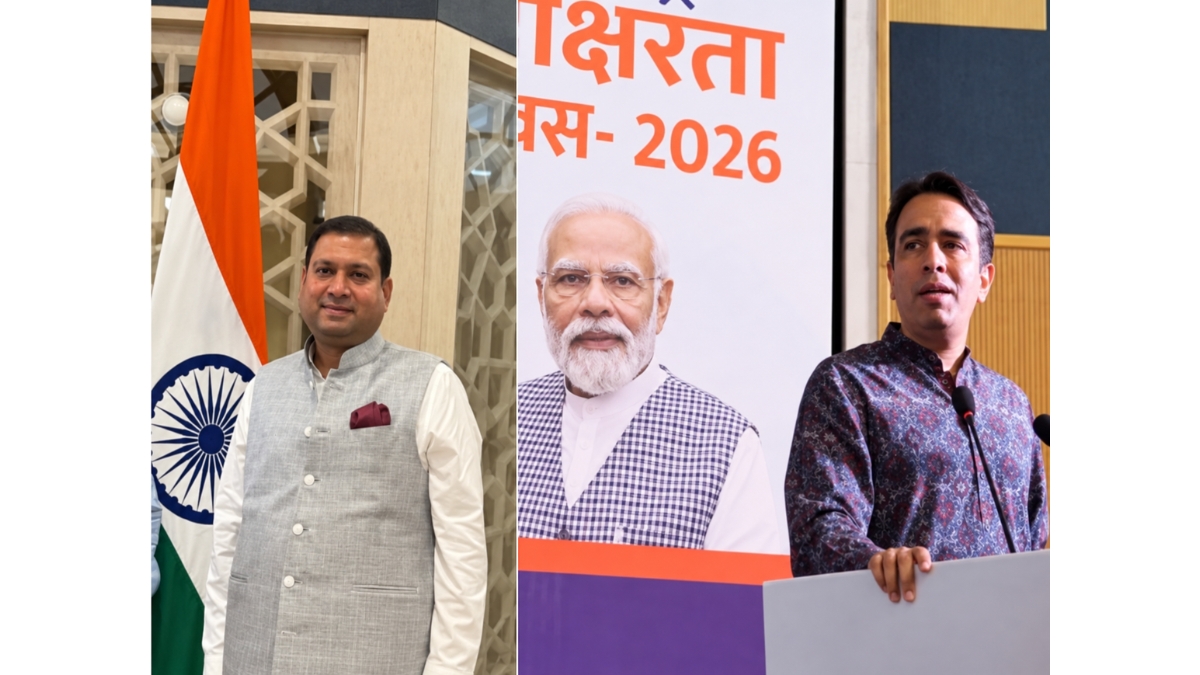
Left (File pic) Sundeep Bhutoria; Right PIB Picture: Minister of State (Independent Charge) for Education, Jayant Chaudhary at the International Literacy Day in Delhi
Kolkata (West Bengal) [India], September 9: The weight of the Indian schoolchild’s bag — a subject that social and cultural activist Sundeep Bhutoria has pressed with the Union Ministry of Education through the past week — was raised from the national stage on 8 September, when Shri Jayant Chaudhary, Hon’ble Minister of State (Independent Charge) for Education, spoke about the School Bag Policy, 2020, at the International Literacy Day celebration in New Delhi. The Minister’s office also posted a short video on X and thanked Shri Bhutoria for highlighting this important matter.
Addressing the gathering, the Minister recalled that the school bag policy had been formulated by the Ministry of Education and circulated to all stakeholders and to state governments, and that it laid down that no student should carry a school bag weighing more than ten per cent of the child’s own body weight. Shri Chaudhary then put the question that campaigners have been putting for years – “How much of that policy has actually been implemented?”
He sought the cooperation of state governments and of the education leadership present, and suggested that UDISE, the Ministry’s own school data system, could be used to verify whether school management committees and school safety committees have in fact been constituted, and whether the guidelines are being followed at the level of the individual school.
“To hear the Hon’ble Minister ask, from a national platform, how much of the school bag policy has actually been implemented is the most encouraging development this campaign has seen,” said Mr Sundeep Bhutoria.
“That is precisely the right question. The guidelines are sound, the courts have spoken, and the states have shown it can be done. What remains is measurement and follow-through, and the Ministry already has the instrument for it in UDISE. I am grateful to the Minister for his time and for taking this up,” he said.
The Minister’s remarks came at the end of a week in which Mr Bhutoria had carried the question directly to the Ministry.
It began with a formal written appeal to Shri Jayant Chaudhary, calling for a robust national push to implement the School Bag Policy, 2020. Mr Bhutoria argued that India’s framework was not the problem — the ten per cent benchmark is scientifically grounded, aligned with the National Education Policy 2020, and rests on the directions of the Madras High Court in M. Purushothaman v. Union of India (2018) and the Kerala High Court in Johny Cyriac v. MHRD (2020). What was missing, he said, was consistent enforcement.
The appeal, shared on his official X handle, was re-shared and endorsed by brand strategist Suhel Seth, drew comment from Grammy Award winner Ricky Kej, and was backed by author and parliamentarian Shashi Tharoor, who wrote that seeing little children groaning under the weight of their bags was deeply disturbing.
The Minister’s office contacted Mr Bhutoria and broadly discussed the consequences of overloaded bags and the practical difficulty of moving an advisory framework onto the ground and asked Mr Bhutoria for concrete suggestions.
Mr Bhutoria responded on 7 September 2026 with a detailed letter of thanks setting out six measures capable of immediate implementation: functional weighing scales in every school; public display of permissible bag weights at gates, notice boards and parent waiting areas; quarterly surprise inspections and flying squads on the Chandigarh model; timetables that spread subjects evenly, with teachers specifying in advance the books required for the next day; a mandatory school-bag compliance indicator built into existing national and state systems of school reporting, grading and accreditation; and statutory backing to convert the 2020 guidelines into a binding policy with proportionate consequences for repeat violations.
A second set of forward-looking proposals covered block timetabling, term-wise textbooks and shared sets, low-cost E-Ink readers and QR-linked hybrid textbooks, ergonomic and sensor-equipped bag design, and bagless digital classrooms.
The Minister’s address corresponds closely to what Mr Bhutoria had placed before him. The first is the diagnosis itself: that the policy exists and has been circulated, and that the open question is implementation rather than formulation.
The national survey conducted while the policy was being framed found that 77.7 per cent of parents regard heavy school bags as a serious problem for their children. Medical opinion links chronic strain from overloaded bags to persistent back pain, muscle strain, postural disorders and spinal conditions including scoliosis.
This is not the first time Mr Bhutoria has pursued a matter of ordinary difficulty with a Union Ministry. In 2017, he wrote to the then Minister of External Affairs, the late Sushma Swaraj, about the health risks of requiring newborns and infants to appear in person at Passport Seva Kendras for biometric registration. After sustained follow-up, the rules were changed to exempt children below the age of five from appearing at the Kendras.
If you object to the content of this press release, please notify us at pr.error.rectification@gmail.com. We will respond and rectify the situation within 24 hours.
