

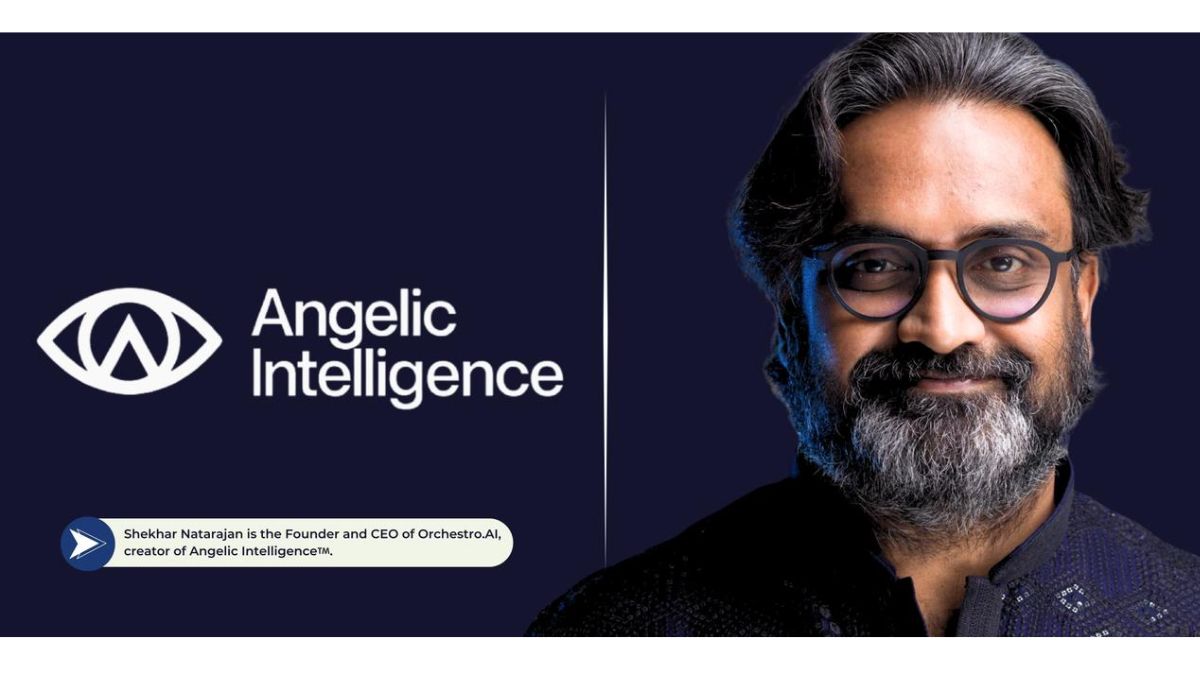
New Delhi [India], February 18: From studying under streetlights in Secunderabad to becoming the CEO of Orchestro AI, Shekhar Natarajan’s life story has inspiring, to say the least. His trajectory has been a rare blend of corporate mastery and purpose-driven reinvention, starting with his journey in America with $34 in his pocket.
He had grown up in South Central India, in a one-room house in Secunderabad where his family lived without electricity. He studied under street lights because there was no other way to read at night. His mother bound newspapers to earn a few rupees; when he needed money for education, she pawned her wedding ring for 30 rupees.
That sacrifice — a mother’s wedding ring traded for a son’s future — shaped everything that followed.
“Real wealth is not money,” Natarajan says. “Real wealth is wisdom. My mother understood that. She gave up her most precious possession so I could learn. That’s not optimization — that’s love.”
The Corporate Ascent
From those beginnings, Natarajan built one of the most remarkable careers in American business. He earned degrees from Georgia Tech, MIT, Harvard Business School, and IESE. He spent 25 years in Fortune 500 leadership at companies including Coca-Cola, PepsiCo, Walmart, Target, Disney, and American Eagle.
At Walmart, he grew the grocery business from $30 million to $5 billion. He pioneered crowdsourced delivery systems that transformed how products reach consumers. At Disney, he helped create the MagicBand experience that millions of visitors now take for granted. Along the way, he accumulated over 207 patents.
He was, by any measure, a master optimizer — someone who understood how to squeeze efficiency from complex systems, how to make supply chains faster and cheaper, how to scale operations across continents.
And then he looked at what optimization had wrought.
The Reckoning
“I spent decades making systems more efficient,” Natarajan reflects. “Faster. Cheaper. More scalable. And I was good at it. But efficiency without ethics is just sophisticated cruelty.”
He saw delivery workers pushed to dangerous speeds by algorithms he could have designed. He saw loan collection systems that automated harassment with techniques he could have invented. He saw welfare systems that deleted hungry children from databases with the same dispassion they’d delete duplicate records.
The skills he had spent a lifetime developing were being used to harm people. Not by villains — by systems. By algorithms optimizing for metrics that didn’t include human dignity.
“The people building these systems aren’t evil,” he says. “They’re optimizing for the metrics they’re given. The problem is that the metrics don’t include compassion. They don’t include dignity. They don’t include the child asking her mother for rice.”
The Morning Practice
Every morning at 4 AM, Natarajan practices classical Indian painting.
It is both artistic expression and problem-solving methodology. The discipline of the brush, the patience of the stroke, the attention to detail — these are not separate from his work on AI. They are preparation for it.
“Building technology with love, not speed, over thousand-year timeframes” — this is how he describes his philosophy. It sounds impractical until you realize what the alternative has produced.
Move fast and break things. Santoshi Kumari was broken.
Disrupt everything. Bhupendra Vishwakarma’s family was disrupted.
Scale at all costs. The cost was paid by gig workers dying on the roads.
“We’ve tried building technology fast,” Natarajan says. “Now let’s try building it right.”
The Wedding Ring
Natarajan still thinks about his mother’s wedding ring.
“She didn’t optimize,” he says. “She sacrificed. She gave up something precious so something more precious could grow. That’s what love does. That’s what the best technology should do — not extract value, but create space for human flourishing.”
Angelic Intelligence is, in some ways, an attempt to encode that mother’s love into computational systems. To build AI that asks, before every action: Does this help people flourish? Does this create space for dignity? Does this honor the sacrifice of those who came before?
It’s an audacious project. It may be an impossible one.
But someone has to try.
“I came from nothing,” Natarajan says. “I studied under street lights. I know what it means to be invisible to systems. And I know that the child asking for rice in Jharkhand is not a deletion error. She’s a human being. If our technology can’t see that, our technology is broken.”
He pauses.
“My mother pawned her wedding ring so I could have a future. I’m trying to build AI that honors that sacrifice — AI that sees every human being as worthy of that kind of love.”
If you object to the content of this press release, please notify us at pr.error.rectification@gmail.com. We will respond and rectify the situation within 24 hours.
