

For UK companies evaluating India, the timing has become particularly significant. The UK–India Comprehensive Economic and Trade Agreement (CETA) came into force on 15 July 2026, creating a more predictable framework for businesses trading and operating between the two countries. The commercial relationship is already substantial, with total UK–India trade reaching £48 billion in 2025. More importantly, the UK government’s impact assessment estimates that the agreement could increase UK exports to India by nearly 60% in the long run, equivalent to an additional £15.7 billion when applied to projected 2040 trade levels. (GOV.UK)
Businesses are looking beyond exports towards establishing teams and capabilities in India, however, market opportunity is only the beginning. Entity requirements, location decisions, workplace design, technology, security, talent readiness and ongoing operations all have to come together. This is the gap Officebing is building its GCC proposition around: giving international companies one accountable workplace partner from India entry through Day 1 and subsequent expansion.
From Deciding on India to Building an Operating Base
Setting up an India operation involves several workstreams that can easily become disconnected. Legal and statutory requirements may move on one track, location evaluation on another, while workplace design, technology, security and employee readiness each involve their own decisions and stakeholders.
Officebing’s GCC framework is designed to bring these workstreams into a managed workplace plan. For companies entering India, its scope includes support for entity incorporation and statutory requirements through specialist legal and compliance partners, alongside location strategy, managed or build-to-suit offices, technology, security and workplace readiness.
An 8 to 12-Week Workplace Readiness Framework
Speed matters during international expansion, but timelines also need to be credible. Officebing uses an indicative 8 to 12-week timeline specifically for workplace readiness, with the actual period depending on scope, location, approvals, and team size.
The process is structured so that several workstreams can progress in parallel. Initial establishment requirements can begin alongside city, location, and capacity planning. Workplace design and delivery then move forward with connectivity, access management, surveillance and IT infrastructure. By the final phase, these elements converge around Day 1, when the workplace is ready for the team to begin operating. Importantly, the 8 to 12-week timeframe does not imply that incorporation, hiring, and every aspect of GCC establishment will always be completed within that period. It refers specifically to getting the workplace ready, a distinction that gives international businesses a more realistic basis for planning their launch.
The First Office Does Not Have to Be the Final Office
For a UK business entering India, one of the difficult early decisions is determining how much space to commit to before the local operation has established its growth trajectory. Officebing addresses this through managed offices and build-to-suit workplaces that can be configured around current requirements and expanded as the GCC develops. A company can begin with its initial team and subsequently add seats, take additional floors or establish operations in another city without treating each stage as an entirely separate workplace project.
This becomes particularly relevant because the trade agreement itself gives specific attention to smaller businesses. Chapter 19 of CETA is dedicated to SMEs, with commitments around accessible trade information, cooperation, and reducing barriers that smaller businesses can face when entering international markets. (GOV.UK) For a mid-sized UK company exploring India, a workplace model that does not require it to design immediately for its eventual scale can complement that broader environment for market entry.
Enterprise Infrastructure From the Beginning
An India operation also needs to function as part of the parent organisation, particularly when teams are handling technology, financial, analytical or other business-critical responsibilities. Officebing’s GCC offering therefore places technology and security within the initial workplace design rather than treating them as additions after the office has been built. Depending on enterprise requirements, this can include connectivity, network infrastructure, access management, surveillance and workplace technology.
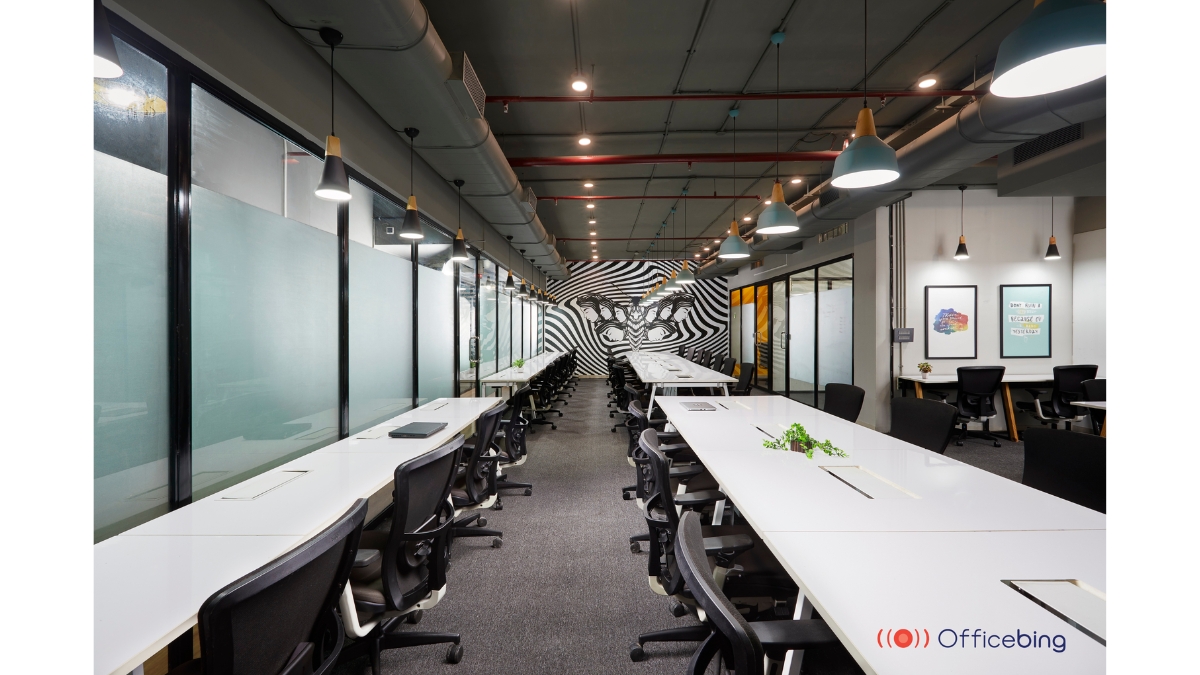
The approach is visible at Officebing’s new Vashi centre on Palm Beach Road, which forms part of its growing network of locations. Its operational footprint includes Vashi, Ghansoli, Turbhe and Seawoods in Navi Mumbai, along with Vikhroli in Mumbai. Officebing is also preparing to expand further with upcoming centres in CBD Belapur and Thane, strengthening its presence across the Mumbai Metropolitan Region.
Scaling Begins After Day 1
A GCC strategy does not end when employees enter the office. In many cases, that is when the next set of requirements begins. Officebing’s model extends into facilities, hospitality, vendor management, workplace technology and everyday office operations. As the business grows, the same framework can support additional capacity, dedicated enterprise floors, new locations or multi-city expansion.
This gives UK companies a different way to think about India entry. Rather than solving separately for the first office, its operation and its eventual expansion, the workplace can be planned as infrastructure capable of evolving alongside the business. Officebing says it has already supported more than 100 companies, delivered over one million sq. ft. of workspace and built a presence across six or more locations in India. These are company-reported figures from its GCC proposition and provide context for the operational base on which it is developing the offering.
A More Practical Route Into India
CETA does not remove the complexity of establishing an operation in another country. What it does is create a stronger framework for UK–India commercial activity. The UK government’s economic assessment estimates that the agreement could eventually increase bilateral trade by nearly 39%, equivalent to £25.5 billion annually when applied to projected 2040 trade levels. (GOV.UK) If that translates into more UK businesses building teams and capabilities in India, their requirements will extend well beyond finding available office space.
They will need a location strategy, an operational workplace, technology and security infrastructure, coordination across setup workstreams and a plan for what happens when the first team becomes a much larger one. That is the role Officebing is positioning itself to play. Its proposition is not simply to provide a UK company with its first desks in India. It is to create the workplace foundation on which the company’s India operation can establish itself, reach Day 1 and continue scaling from there.
If you object to the content of this press release, please notify us at pr.error.rectification@gmail.com. We will respond and rectify the situation within 24 hours.
