

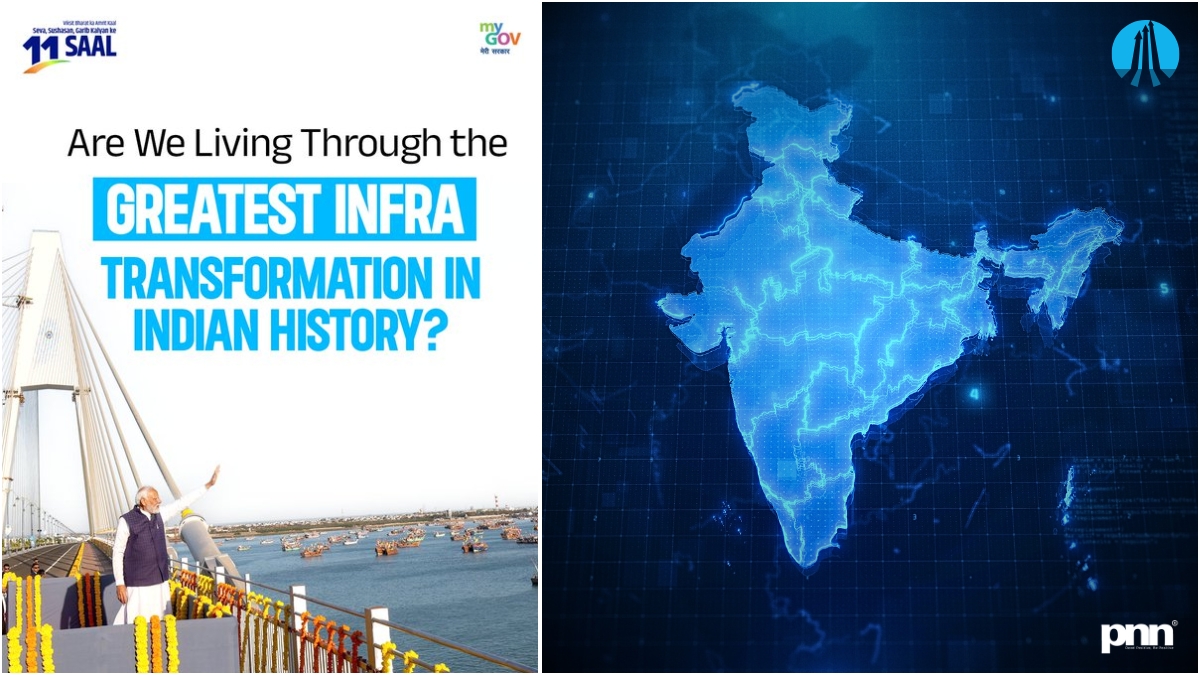
New Delhi [India], June 11: In a powerful reflection on over a decade of relentless progress, Prime Minister Narendra Modi commemorated 11 Years of Infrastructure Revolution in India, highlighting the nation’s extraordinary journey from fragmented connectivity to a seamless, world-class infrastructure network.
As India continues to race toward a $5 trillion economy, the transformation of its physical backbone stands as a testament to both vision and execution.
On June 11, 2025, the Prime Minister took to X (formerly Twitter) to mark this milestone. “It’s been #11YearsOfInfraRevolution,” he wrote, “with outstanding infrastructure being added that has enhanced India’s growth trajectory.
From railways to highways, ports to airports, India’s rapidly expanding infra network is boosting ‘Ease of Living’ and enhancing prosperity.”
It’s been #11YearsOfInfraRevolution, with outstanding infrastructure being added that has enhanced India’s growth trajectory. From railways to highways, ports to airports, India’s rapidly expanding infra network is boosting ‘Ease of Living’ and enhancing prosperity. https://t.co/HdVHoJabjS
— Narendra Modi (@narendramodi) June 11, 2025
Indeed, the last 11 years have ushered in a new era of progress powered by smart policy, sustainable thinking, and unparalleled execution on the ground.
What was once an aspiration, world-class infrastructure accessible to all corners of India, is now taking concrete shape, quite literally.
From Aspirations to Assets: A Decade of Development
The infrastructure revolution in India began in earnest with a national strategy that transcended political slogans. Roads were not just built, they were expanded into economic corridors. Railway tracks were not just laid; they were electrified, modernised, and made faster. Airports were not just upgraded, they became gateways for regional and global trade.
With the addition of more than 50,000 km of national roads in only ten years, India now has one of the fastest-growing highway networks in the world.
Just the Bharatmala and Sagarmala projects have changed the way people and commodities travel throughout the subcontinent. Under the UDAN program, rural airports have democratised air travel, while ports have expanded their capacity to handle cargo.
Increased commerce, improved logistics, more jobs, and a noticeable improvement in the quality of life have all resulted from the massive knock-on effects. The infrastructure canvas today depicts a revitalised India that is bold, ambitious, and linked, spanning from the most isolated Northeastern areas to the busy metropolises of Delhi, Mumbai, and Chennai.
The Soul Behind the Steel: A Vision for Sustainability
What sets this revolution apart is not just the scale but the sustainability embedded in it. Whether it is the widespread push for electric railways or the adoption of green construction methods on highways, the government’s approach underscores long-term vision rather than short-term optics.
As Prime Minister Modi reiterated, “India’s push for next-gen infrastructure is powered by sustainability and long-term vision. It is laying the foundations of a self-reliant India.”
Projects like the National Infrastructure Pipeline (NIP) and Gati Shakti have accelerated over 7,000 projects and brought collaboration across many ministries, acting as force multipliers. These are structural structures intended to endure political cycles and benefit future generations, not just plans.
Empowering Through Infrastructure: The Human Element
Infrastructure is often seen as steel, concrete, and glass, but its real value lies in people. The roads that shorten a farmer’s journey to the market, the railway that connects students to universities, the airport that brings families closer, the digital infrastructure that powers e-learning and telemedicine, these are stories of empowerment.
In this context, the Prime Minister also spotlighted Union Minister Ashwini Vaishnaw’s article reflecting on 11 years of inclusive growth. In his words, the journey has “benefited citizens in multiple ways and, more importantly, instilled a belief. A belief that empowers, uplifts, and propels the nation forward.”
Union Minister Shri @AshwiniVaishnaw reflects on 11 years of inclusive growth, a journey that has benefited citizens in multiple ways and, more importantly, instilled a belief. A belief that empowers, uplifts, and propels the nation forward.
An insightful read! pic.twitter.com/VDl5Sf8gzT
— PMO India (@PMOIndia) June 11, 2025
Whether it’s access to digital services, better mobility, or stronger rural-urban linkages, the infrastructure revolution in India is as much about inclusion as it is about innovation.
A Nation on the Move, And On a Mission
India’s success in this space has caught the attention of global observers. With infrastructure investment averaging 8% of GDP over the last five years, and flagship schemes like PM Gati Shakti enabling synchronized execution across state and central agencies, India is now a case study in long-term, citizen-centric development.
But the government shows no signs of slowing down. With the upcoming Viksit Bharat 2047 vision, infrastructure will remain the foundation upon which a new India will rise, more inclusive, more self-reliant, and more connected to the future.
As India celebrates this landmark moment, one cannot help but recall the words of a great philosopher, who once said, “You have to dream before your dreams can come true.” In many ways, India’s infrastructure revolution is that dream being paved, track by track, runway by runway.
Also Read: AM/NS India Powers Two of India’s Greatest Rail Engineering Marvels
