

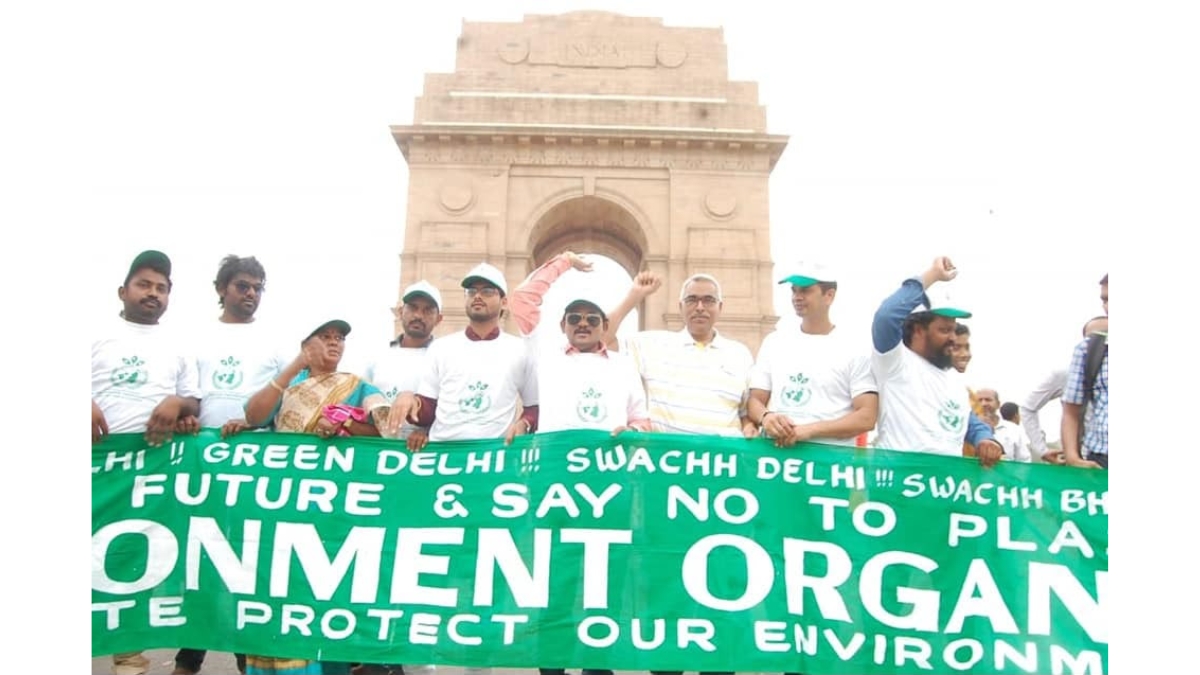
By Dr. C.H. Bhadra & Koneti Nikhil Sai World Environment Organization (WEO)
New Delhi [India], October 9: Every morning across India, millions of children carry plastic tiffins and water bottles to school—an everyday routine harboring an emerging public health risk. Landmark research from the University of Newcastle and the World Wildlife Fund (WWF) indicates that individuals inadvertently ingest approximately 5 grams of microplastics weekly, equivalent to a plastic card. Over a year, this totals 260 grams of synthetic particles entering the body.
Thermal chemical migration worsens this exposure. When warm food is packed into conventional polymer containers, heat accelerates the leaching of endocrine-disrupting chemicals (EDCs) like phthalates and bisphenols. Concurrently, medical studies and epidemiological datasets from The Lancet Oncology and the Indian Council of Medical Research (ICMR) record a 477.8% surge in reported Indian breast cancer cases since 1990, alongside rising clinical reports of pediatric metabolic and hormonal variations.
To counter these environmental toxins through structured interventions, the World Environment Organization (WEO)—a registered Public Charitable Trust headquartered in Hyderabad—is executing an empirical framework to restore Earth’s core elements: Water, Soil, and Air.
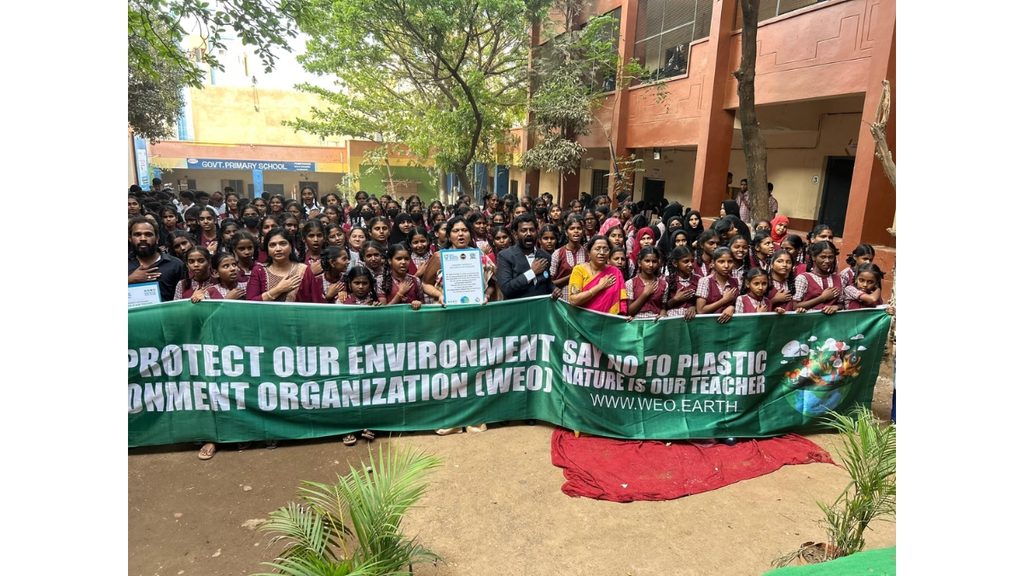
Under the executive administration of General Secretary Koneti Nikhil Sai, working alongside Founder & President Dr. C.H. Bhadra, WEO is driving phased operational programs:
- Water Stewardship: Deploying campus audits and pilot setups reclaiming 75% of reverse osmosis (RO) reject water for horticulture.
- Soil Regeneration: Rebuilding depleted soil organic carbon toward fertile baselines via vermicomposting and Miyawaki micro-plantations.
- Clean Air: Piloting high-albedo roof cooling (moderating indoor temperatures by 2°C to 5°C) and decentralized agritech biomass hubs.
WEO’s Green Rangers Children Project 2050 transitions campuses into low-emission “Living Schools” via the GR3EN Cycle (Grow, Reduce, Engage, Empower, Nourish), utilizing classroom Kaizen boards and the “Sacred Steel & Jute Swap” to replace single-use plastics. Successfully observed at the Sankalp Group Schools and Evergreen Olives School, this zero-CapEx model is scaling nationally. In Telangana, 3,000 educators have completed orientation, with a prospective registry of 10,000 academic leaders mobilized with support of Dr. A. Jyothsna Rao (Principal, Evergreen Olives School; President, Eminent Principals and Eduleaders Association).
Expanding into rural ecosystems, WEO engages over 2,000 village Sarpanches across multiple states, supported by a network of Mohammed Rizwan and CH. Sagar Netha, advancing decentralized agritech and mass gathering sustainability models. WEO invites educational directorates, municipal authorities, and CSR bodies to collaborate on these phased environmental frameworks.
“Let Us Unite – Protect Our Environment” SAVE NATURE – SAVE FUTURE
The microplastics estimate cited here is a population-level, approximate estimate with methodological limitations. It does not establish that every person or child ingests the same amount, nor that plastic containers cause endocrine, metabolic or hormonal disorders
Contact: www.weo.earth | info@weo.earth
Insta : weo.earth
If you object to the content of this press release, please notify us at pr.error.rectification@gmail.com. We will respond and rectify the situation within 24 hours.
