

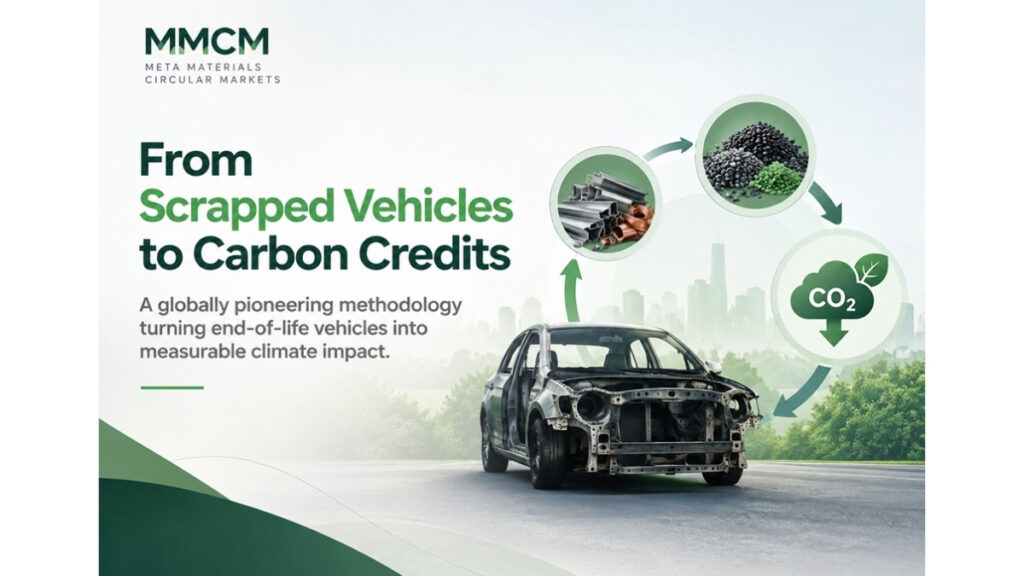
New Delhi [India], September 30: A globally pioneering carbon methodology is transforming end-of-life vehicles from a waste challenge into a measurable climate and circular-economy opportunity.
India is approaching a major turning point in how it manages end-of-life vehicles (ELVs). According to NITI Aayog’s Enhancing Circular Economy of End-of-Life Vehicles (ELVs) in India, the country had approximately 10 million ELVs in circulation in 2020. That number is expected to reach nearly 23 million by the end of 2025 and close to 50 million by 2030. NITI Aayog has highlighted the growing ELV volume as an urgent need for stronger systems for sustainable management, while also identifying resource recovery and reduced dependence on virgin materials as significant opportunities.
Against this rapidly growing challenge, Meta Materials Circular Markets (MMCM) has helped address this gap through CM-WM-ELV-01 : Recovery and Recycling of Materials from End-of-Life Vehicles, a methodology approved under the Cercarbono certification programme.
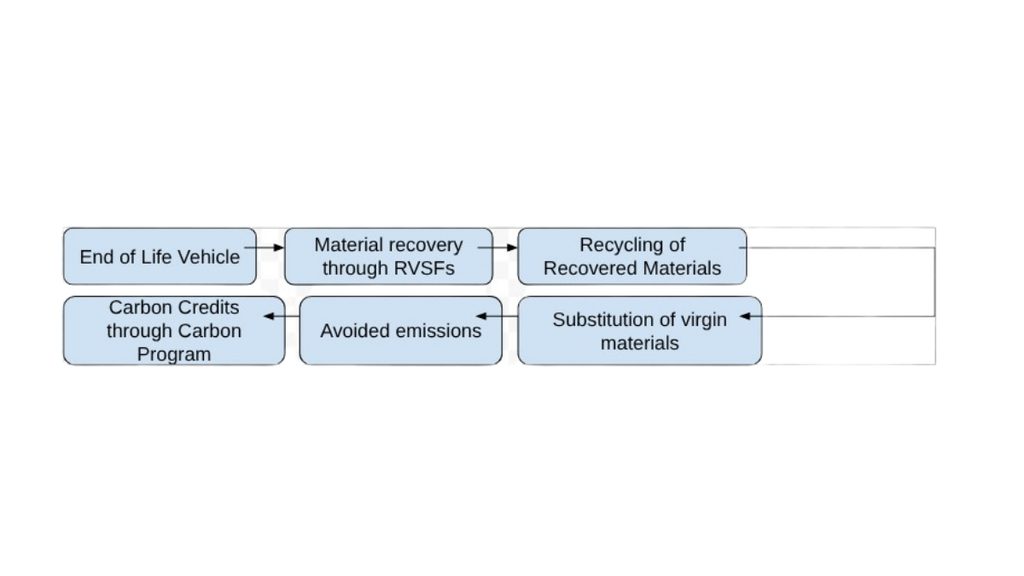
The methodology provides a framework to quantify the greenhouse-gas emission reductions associated with recovering and recycling materials from ELVs and reducing the need for equivalent virgin material production.
In doing so, it takes vehicle scrapping beyond waste management and into the carbon market.
A Global First for ELV Carbon Accounting
The significance of the methodology lies in its focus: ELV material recovery and recycling as a dedicated carbon-crediting activity.
Instead of looking at a scrapped vehicle simply as waste, the methodology recognises the climate value of recovering materials such as metals, plastics and other components and returning them to productive use.
This creates a direct link between the physical circular economy and carbon finance:
For a sector facing a rapidly increasing material stream, this represents a new way to mobilise climate finance towards formal vehicle recycling infrastructure.
What Sets the MMCM Approach Apart?
The methodology is designed to connect real-world material recovery with measurable climate outcomes, while creating a pathway for the growing ELV carbon recycling sector to access carbon finance.
- Connecting circularity with carbon finance
The methodology creates a direct link between the recovery and recycling of materials from ELVs and the carbon market. By reducing the need for equivalent virgin material production, the recycling of eligible materials can generate measurable emissions reductions that can be quantified as carbon credits. - Carbon value linked to actual material recovery
The approach does not treat the number of vehicles scrapped as the carbon benefit in itself. Instead, it focuses on the recovery and recycling of materials and the associated emissions reductions. This creates a stronger connection between physical recycling activity and the climate impact being quantified. - Designed for transparency and verification
The methodology incorporates defined monitoring and documentation requirements, with project-level outcomes subject to validation and verification. This supports the development of transparent and auditable carbon assets and aligns the methodology with the growing market emphasis on carbon-credit integrity. - Positioned within an evolving high-integrity carbon market
The integrity of carbon markets is becoming increasingly important to buyers and market participants. In August 2026, Cercarbono was approved as CCP-Eligible by the Integrity Council for the Voluntary Carbon Market (ICVCM), following assessment of its governance, tracking, transparency and independent third-party verification systems. Cercarbono subsequently announced that CM-WM-ELV-01 is among five Cercarbono methodologies being submitted for the ICVCM’s methodology assessment process.
Turning India’s ELV Challenge into a Climate Opportunity
The scale of India’s ELV challenge makes the need for formal, sustainable recycling infrastructure increasingly important. According to the Ministry of Road Transport and Highways (MoRTH), as reported by the Press Information Bureau (PIB), as of 30 January 2026, 129 Registered Vehicle Scrapping Facilities (RVSFs) were operational across 21 States and Union Territories, having collectively scrapped approximately 0.43 million vehicles. As India continues to build out its formal vehicle-scrapping ecosystem, creating viable economic incentives for environmentally sound recovery and recycling will be critical.
MMCM’s ELV carbon methodology provides a mechanism through which this growing formal recycling ecosystem can potentially access an additional source of climate finance, linking material recovery with measurable emissions reductions.
The ambition is straightforward: as more vehicles reach the end of their useful lives, more of their materials can be recovered, recycled and returned to the economy, while the associated climate benefits can be measured and recognised through the carbon market.
The result is a new proposition for the circular economy: a scrapped vehicle does not have to mark the end of its value. Its materials can begin a new lifecycle, while their recovery can contribute to measurable climate action and generate potential carbon-market value.
