

Key Takeaways
- Persistent Spending Deficit: At roughly 1.9% of GDP, India’s public healthcare expenditure remains significantly below the 2.5% target outlined in the National Health Policy 2017, driven by heavy sovereign debt and fiscal constraints across state governments.
- High Out-of-Pocket Burden: Despite a gradual drop in Out-of-Pocket Expenditure (OOPE) to 43.4% of Total Health Expenditure, Indian households still face substantial unhedged costs for outpatient visits, diagnostics, and chronic medicines.
- Private Sector Dominance: Operational shortages and underfunded primary health networks in public facilities compel patients to rely on an unregulated, commercially concentrated private healthcare market.
- Economic Cost of Illness: Widespread medical debt, financial shocks, and unmanaged health conditions continue to erode aggregate household savings, impair labor productivity, and restrict national economic growth.
For all the glitzy infrastructure projects and investment commitments that the government keeps boasting about, there remains an expenditure that is quietly overlooked, year by year, government by government. This expenditure is directly linked to our quality of life, and impacts every section of society, including the economy, but the government continues to wash its hands off it, letting the private sector assume responsibility instead.
We’re talking about public health expenditure, which has been the lowest amongst all major global economies, with just about 1.1-1.8% of the Gross Domestic Product (GDP) being spent on it over the last decade. For Financial Year 2026, the government spent about 1.9% of its GDP on health, far below the recommended 2.5% of GDP put forth by the National Health Policy of 2017
For years, successive governments have prioritized physical infrastructure development over the health of its citizens, despite being able to spend enough for their health. Heavy sovereign debt commitments have limited the government’s ability to spend on health infrastructure. With health being both a central and state subject, the centre has traditionally put most of the onus on health spending on the states.
Because revenue-generation capacities vary widely across states, low-income states with higher disease burdens often possess the weakest tax bases and tightest borrowing limits under fiscal responsibility legislation. This structural challenge leaves poorer states unable to match central grants or expand local public health infrastructure, cementing regional health disparities. Furthermore, historical spending has heavily favored capital-intensive tertiary care facilities over decentralized primary health networks, leaving preventive care with just 8.88% of Current Health Expenditure (CHE).
The Human Cost? Out-of-Pocket Expenditure
The primary consequence of persistent public health underfunding is the financial transfer of health risks directly onto private households. Although official NHA estimates show a substantial reduction in Out-of-Pocket Expenditure (OOPE) as a share of Total Health Expenditure (THE)—falling from 64.2% in 2013–14 to 43.4% in 2022–23—household health spending in India remains exceptionally high by global standards. In absolute terms, Indian households paid an average of 121 international dollars per capita in out-of-pocket expenses in 2022, placing the country 64th globally.
For socio-economically at-risk populations, unhedged medical expenses represent a major driver of catastrophic financial shocks and intergenerational poverty. Unlike inpatient hospitalization, which is increasingly covered by social security schemes like Ayushman Bharat (AB-PMJAY), outpatient consultations, diagnostic tests, and chronic medication purchases are predominantly paid out of pocket. When low-income families face sudden health crises, they are frequently forced to liquidate productive assets, sacrifice nutritional needs, or enter high-interest informal debt cycles. This financial risk pooling deficit effectively acts as a regressive tax on the poor, depressing aggregate household savings and lowering long-term domestic consumption expenditure across the economy.
From public to private hands
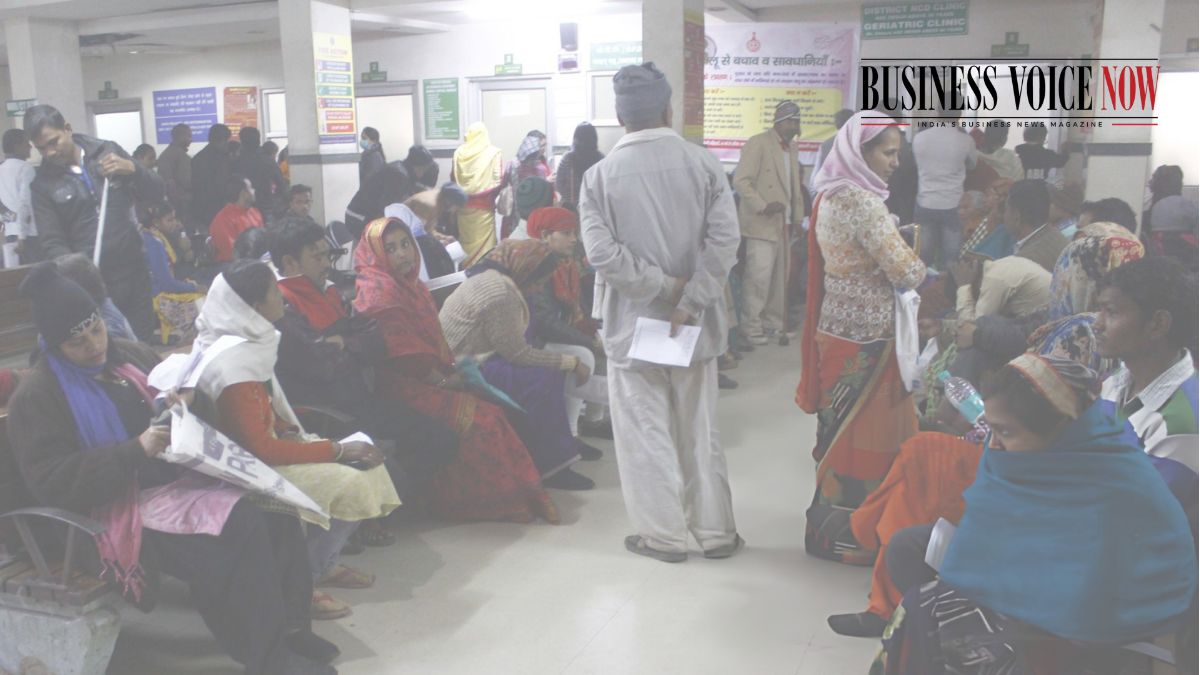
The chronic underfunding of public health services has generated deep systemic distortions across the broader health ecosystem. In the absence of robust public care options, the private sector has expanded rapidly to fill the void, accounting for 30.83% of Current Health Expenditure compared to just 16.73% for government hospitals. This reliance on an unregulated private healthcare market fosters severe supply-side imbalances. Commercial healthcare capital is overwhelmingly concentrated in affluent city centers, where profit margins are secure, creating acute spatial disparities in medical access for rural populations.
Simultaneously, public healthcare facilities suffer from chronic operational deficits, including shortages of trained medical staff, deficient diagnostic equipment, and unreliable pharmaceutical supply chains. These physical and human resource restrictions weaken public trust in state-run clinics, compelling even low-income patients to seek market-priced private care. From a macroeconomic vantage point, this distorted ecosystem exacts a severe toll on national growth. Widespread morbidity, unmanaged chronic conditions, and premature mortality severely impair labor productivity and workforce participation. The resulting drain on human capital accumulation restricts India’s long-term economic convergence and dampens total factor productivity.
Health Financing Indicators and Policy Directions
A comparative evaluation of key health financing metrics spotlights both recent progress and persistent structural gaps within India’s health architecture.
| Health Financing Indicator | FY 2022–23 (Actuals) | FY 2023–24 (RE / Prov.) | FY 2024–25 (RE) | FY 2025–26 (BE) | Long-Term Trajectory & Outlook |
| Government Health Expenditure (GHE) as % of GDP | 1.43% (1.48% Rev.) | ~1.50% | ~1.60% | ~1.65% | Gradual upward momentum towards the 2.5% National Health Policy (NHP 2017) target |
| GHE as % of General Government Expenditure (GGE) | 4.89% | ~5.10% | ~5.35% | ~5.50% | Sustained public prioritization across Union and State health budgets |
| Out-of-Pocket Expenditure (OOPE) as % of THE | 43.4% | ~40.5% (Est.) | ~38.0% (Est.) | ~36.5% (Proj.) | Steady structural decline driven by PM-JAY and primary healthcare expansion |
| GHE Share of Total Health Expenditure (THE) | 43.7% | ~46.0% (Est.) | ~48.2% (Est.) | ~50.0% (Proj.) | Expanding baseline public funding share relative to private household spending |
| Social Security Expenditure on Health as % of THE | 9.9% | ~10.5% (Est.) | ~11.2% (Est.) | ~12.0% (Proj.) | Steady expansion through ESIC, CGHS, and subsidized health coverage schemes |
| Per Capita Government Health Expenditure (INR) | ₹2,786 | ~₹3,150 | ~₹3,580 | ~₹4,020 | Consistent double-digit nominal growth year-over-year |
Source: Ministry of Health & Family Welfare (MoHFW), Union Budget Documents, and NHA Estimates
Reversing the systemic underinvestment in Indian healthcare requires coordinated fiscal and policy intervention. First, the central government must establish institutionalized fiscal transfer mechanisms that assist revenue-constrained states in expanding local healthcare budgets. Second, public allocations must prioritize primary care infrastructure—such as the operationalization of Ayushman Arogya Mandirs—to address disease burdens before they require costly tertiary interventions. Finally, broadening public pharmaceutical procurement programs and regulating private service pricing are important steps toward protecting vulnerable households, reducing OOPE, and fostering an equitable healthcare ecosystem capable of sustaining national development.
